One-off PDF · $9.95 · emailed in ~60 seconds
Official Hail History Report for any US address
Every hail event recorded within 1 mile of the property over the past 10 years — dates, sizes, distances — each line carrying its NOAA Storm Events or NEXRAD radar source ID, plus a live MRMS radar check. Pay once, PDF in your inbox in about a minute.
It documents hail exposure from government weather records — not a roof-damage diagnosis.
See a sample report (Coors Field, Denver — real NOAA-sourced data)
Order your report
Enter the property address you need a report for. We'll email the PDF to the address you provide here within ~60 seconds of payment.
New here? See a full sample report first.
Payment processed by Stripe. We don't store your card. Reports cite NOAA Storm Events and NEXRAD SWDI radar records, with live NCEP MRMS radar context — see the methodology paper. Full refund within 24 hours if the PDF doesn't meet your needs — see refund policy.
See exactly what you get
This is a real report we generated for a public landmark — Coors Field, 2001 Blake St, Denver (not a customer address). Inside: a first page with a map of nearby hail, the property's HailScore™, its 10-year hail snapshot and the date-of-loss result; the event ledger with a source on every row; storm-day hail maps; how the report was assembled; and its sources. Same layout, sources, and date-of-loss block as a paid order.
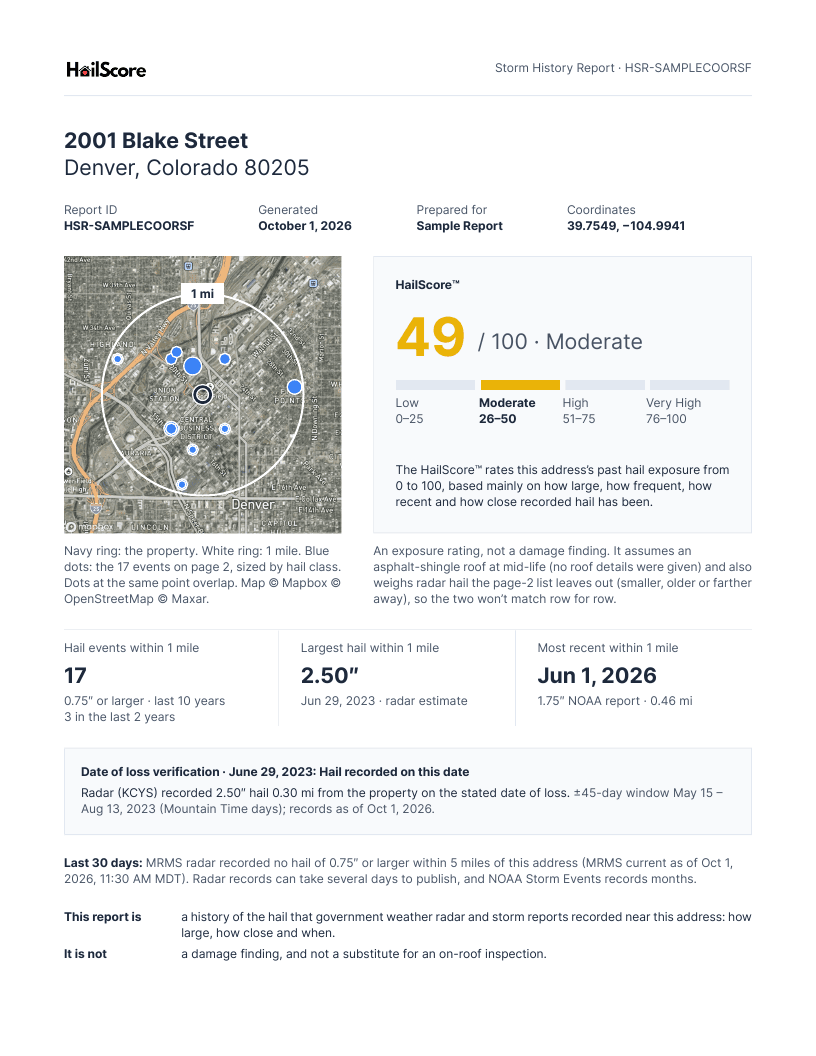
- The date-of-loss answer on page 1. In this sample, a 2.50" hail event lands on the stated date of loss — page 1 says so and names the radar station that recorded it.
- A source ID on every event. Each line of the 10-year ledger carries its radar station or NOAA Storm Events record number, so anyone can check it against noaa.gov.
- Honest by design. The report states what it establishes and what it doesn't — exposure, not roof damage. If the records show nothing on your date, it says that too.
- Your report uses your address and, if you enter one, your date of loss.
What's inside
Every hail event in the past decade
Within 1 mile of your address. Date, time (in your local time zone), hail size in inches, distance from your property, and the NOAA or NEXRAD source ID for each one.
Source citations defense counsel can verify
NOAA Storm Events database number or NEXRAD radar station ID on every event, plus live MRMS radar context for the last 30 days. Every claim in the PDF traces back to a government record.
Government-record ledger formatting
Black-letter formatting, source provenance footer, ready to drop into a claim packet, supplement, or litigation file.
The free check vs. the official PDF
Most people don't need the PDF — the free check answers “what hit my address?” on screen. Order the report when you need the record as a document.
Free HailScore check
- 0–100 hail exposure score
- Interactive storm map + event timeline
- Any US address · no signup · free forever
Official Hail History Report — $9.95
- Every event within 1 mile, past 10 years
- Government source ID on every event
- Optional date-of-loss status (±45-day window)
- Works-cited PDF, emailed in ~60 seconds
Frequently asked questions
What's inside the Official Hail History Report?+
Every hail event recorded within 1 mile of the address over the past 10 years: date, estimated hail size, and distance from the property, with each line carrying its government source ID (NOAA Storm Events number or NEXRAD radar signature), plus a live MRMS radar recent-activity check. Plus a storm map, a data-sources page, and works-cited formatting.
Is this proof of roof damage?+
No. The report documents hail exposure — what government weather records show fell near the address — not physical damage. Radar and storm databases cannot see your shingles; only an on-roof inspection can confirm damage. The report's job is to document the weather record, accurately and citably.
How fast do I get the PDF?+
It's generated and emailed about 60 seconds after payment clears. If it hasn't arrived within a few minutes, check spam, then email hello@myhailscore.com and we'll resend it.
Where does the data come from?+
The PDF's event ledger draws on two government archives: the NOAA Storm Events Database and NEXRAD radar hail signatures (Severe Weather Data Inventory). Live MRMS MESH radar estimates power the recent-activity check on page 1. Every event in the PDF names its publisher and record ID so anyone can check it against the primary source. The wider HailScore platform also ingests NWS alerts for its live storm alerts and CoCoRaHS volunteer observations for its free score, and adds SPC Local Storm Reports to its record index weekly; the SPC records that take part in scoring are a separate Colorado ground-report archive covering 1955–2023.
Who is this report for?+
Homeowners who want the property's hail history on file, independent and public adjusters checking a reported date of loss, attorneys who need source-cited storm documentation, and buyers or sellers documenting a roof's exposure history. It's the same government data for everyone — formatted so a third party can verify each line.
What's the difference from the free HailScore check?+
The free check on the homepage gives you the 0–100 exposure score, the interactive storm map, and the event timeline on screen — free, always. The paid PDF is for when you need it as a document: a strict 1-mile event ledger with per-event source IDs, optional date-of-loss status, and works-cited formatting. If the on-screen answer is enough, you don't need the PDF.
What if there's no hail in the report?+
Then that's what it says — the report reflects the records, including the absence of events, and a documented "no recorded events" can be exactly what you need on file. If the PDF doesn't meet your needs for any reason, there's a full refund within 24 hours of purchase.
What does the date-of-loss field do?+
It's optional. If you enter a date of loss, the PDF's first page states whether a qualifying hail event appears on that exact date, within the industry-standard ±45-day window, or not at all — with the matching events listed. Adjusters use this to anchor a reported claim date to the weather record.
More on what radar can and can't establish: what radar can and cannot prove · methodology
Pulling more than one a month?
See full pricing: Free Pro beta · $9.95 one-off PDF · Pro app $33/mo after a 14-day trial · Team $49/mo (25 reports) · Firm $199/mo (150 reports). Branded PDFs, bulk lookup, and API access on volume plans.